

The War on Aliens! Are they taking over your piece of the earth? How to successfully eradicate aliens . . .
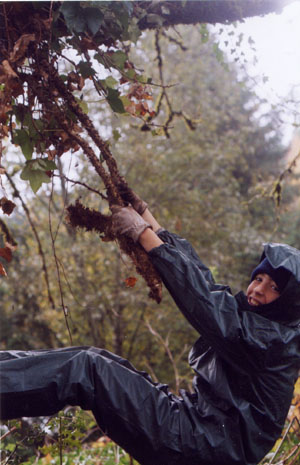
a SOLV volunteer romoves ivy from a tree at Fields Creek, saving the tree
photo © Lory Duralia
Western North American wildlife has been challenged by introduced species since the pioneers cultivated the land. We continue to disrupt habitats that had bargained for centuries to achieve an equilibrium and support a rich diversity of native plants and animals when we introduce and encourage “exotic”, or non-native, species that are invasive. Spreading out and inhabiting natural spaces, they often take over.
The bullfrog has displaced native amphibians in many places; since introduced (for frog legs – bon apetit!), it has increased in numbers sufficient to threaten native populations of frogs and turtles. Red-legged frog, western pond turtle, and painted turtle populations have declined because of predation by bullfrogs, who eat tadpoles and eggs, in addition to habitat loss and degradation. Here at the nursery, a bullfrog threatened our native red-legged frogs and tree frogs, so we caught it in a trap (they like cat food and sardines), and banished it! You can tell a bullfrog by its habit of making a “eeeeeeeee!” sound when it jumps; native Pacific tree frogs, on the other hand, serenade us with their familiar “ribit” throughout the evening and night hours every spring during mating season, and red-legged frogs communicate under water.
Many non-native plants have invaded greenspaces and choked out native plants. Buddleia (butterfly bush) planted in gardens spreads by seed and quickly takes over. It has recently been added to the Portland nuisance plant list (below) because of its aggressive nature. Good substitutes for buddleia include Ceanothus thrysiflorus, a beautiful native evergreen with gorgeous blue flowers in spring, and any of our native Spireas. See our butterfly page for more suggestions! Other invasive “exotics” include English ivy, which competes with native vegetation in many woodlands, and wins, often killing trees in its path, and Canary reed grass, which has choked out native grasses and undergrowth in open spaces all over our region.
There are many examples of introduced plants and animals that threaten native species, and much every gardener can do. Do not plant invasive exotic species, whose seeds are often spread by birds and wind to habitats outside your own garden. Volunteer to eradicate invasive species with an environmental organization – there are many annual “ivy pulls” in a variety of public spaces every year. And of course, plant native! to renew declining species and feed native wildlife. Remember to plant natives densely when removing invasive exotics from your land, so that they have a chance to out-compete re-emerging nuisance plants.
The city of Portland’s natural resource protection program aims to educate the public about our natural heritage and “promote the continued viability and diversity of indigenous plant and animal communities”. Portland developed a ‘Native Plant List’ to help people choose appropriate species for planting, as well as a ‘Nuisance Plant List’ and ‘Prohibited Plant List’, which I have included below. Nuisance plants may be native, naturalized or exotic, and they are considered a nuisance because of their tendency to dominate plant communities or because they are harmful to humans. Prohibited plants are those the city prohibits from use in all reviewed landscaping situations within the city limits. The plants on this list pose a serious threat to the health and vitality of native plant and animal communitities; even if the regulations do not apply to you, you can use the list as a guide to responsible landscaping. In addition, the Oregon Department of Agriculture Noxious Weed List can be found online at: oda.state.or.us/Plant/weed_control/index.html
| Scientific Name | Common Name |
| Cytisus scoparius | Scot’s Broom |
| Hedera helixd | English Ivy |
| Lythrum salicaria | Purple Loosestrife |
| Phalaris arundinacaea | Reed Canarygrass |
| Rubus discolor | Himalayan Blackberry |
| Scientific Name | Common Name |
| Acroptilon repens | Russian knapweed |
| Aegopodium podagraria and variegated varieties | Goutweed |
| Agropyron repens | Quack grass |
| Alopecuris pratensis | Meadow foxtail |
| Anthoxanthum odoratum | Sweet vernalgrass |
| Arctium minus | Common burdock |
| Arrhenatherum elatius | Tall oatgrass |
| Betula pendula lacinata | Cutleaf birch |
| Brachypodium sylvaticum | False brome |
| Bromus diandrus | Ripgut |
| Bromus hordeaceus | Soft brome |
| Bromus inermis | Smooth brome-grasses |
| Bromus japonicus | Japanese brome-grass |
| Bromus sterilis | Poverty grass |
| Bromus tectorum | Cheatgrass |
| Buddleia davidii | Butterfly bush |
| Callitriche stagnalis | Pond water starwort |
| Cardaria draba | Hoary cress |
| Carduus acanthoides | Plumeless thistle |
| Carduus nutans | Musk thistle |
| carduus pycnocephalus | Italian thistle |
| Caraduus tenufolius | Slender flowered dthistle |
| Centaurea biebersteinii | Spotted knapweed |
| Centaurea diffusa | Diffuse knapweed |
| Caentaurea jacea | Brown knapweed |
| Centauarea pratensis | Meadow knapweed |
| Chicorum intybus | Chicory |
| Chondrilla juncea | Rush skelotonweed |
| Dipsaucus fullonum | Common teasel |
| Euphorbia lathyrus | Mole plant |
| Festuca arundinacea | Tall fescue |
| Foeniculum vulgare | Fennel |
| Galium odoratum | Sweet woodruff |
| Geranium lucidum | Shining geranium |
| Geranium robertianum | Robert geranium |
| Geum urbanum | European avens |
| Heracleum mantegazzianum | Giant hawkweed |
| Hieracium aurantiacum | |
| Hieracaium cespitosum | Yellow hawkweed |
| Hieracium laevigatum | Smooth hawkweed |
| Hieracium pilosella | Mouse-ear hawkweed |
| Holcus lanatus | Velvet grass |
| Houttuynia cordata | Chameleon plant |
| Hydrilla verticillata | Hydrilla |
| Hypericum perforatum | St. John’s Wort |
| Hypocharis radicata | Spotted cat’s ear |
| Ilex aquafolium | English holly |
| Impatiens glandulifera | Policemen’s helmet |
| Iris pseudacorus | Yellow flag |
| Juncus effusus v. effusus | European soft rush |
| Laburnum watereri | Golden chain tree |
| Lactuca muralis | Wall lettuce |
| Lactuca serriola | Prickly lettuce |
| Lamium maculatum | White Nancy |
| Lapsana communis | Nipplewort |
| Lemna minor | Duckweed, Water lentil |
| Leontodon autumnalis | Fall dandelion |
| Leucanthemum vulgare | Oxeye daisy |
| Ligustrum vulgare | Privet |
| Linaria dalmatica ssp. dalmatica | Dalmation toadflax |
| Linaria vulgaris | Yellow toadflax |
| Lolium multiflorum | Annual ryegrass |
| Lotus corniculatus | Bird’s foot trefoil |
| Ludwigia hexapetala | Water primrose |
| Lunaria annua | Money plant |
| Lychnis alba | White campion |
| Lysimachia nummularia | Creeping jenny |
| Lythrum portula | Spatula leaf purslalne |
| Melilotus alba | Sweetclover |
| Melilotus officinalis | Yellow sweetclover |
| Melissa officianalis | Lemon balm |
| Mentha pulegium | Penny royal |
| Myriophyllum aquaticum | Parrots feather |
| Myriophyllum spicatum | Eurasian watermilfoil |
| Nymphaea odorata | Fragrant water lily |
| Onopordum acanthium | Scotch thistle |
| Panicum capillare | Witchgrass |
| Parentucellia viscosa | Parentucellia |
| Paulownia tomentosa | Princess tree |
| Phalaris aquatica | Harding grass |
| Phleum pratensis | Timothy |
| Phragmites australis | |
| Phytolacca americana | Pokeweed |
| Poa annua | Annual bluegrass |
| Polygonum aviculare | Doorweed |
| Polygonum coccineum | Water smartweed |
| Polygonum convolvulus | Climbing bindweed |
| Polygonum cuspidatum | Japanese knotweed |
| Polygonum polystachymum | Himalayan knotweed |
| Polygonum sachalinense | Giant knotweed |
| Populus alba | White poplar |
| Potamogeton crispus | Curly leaf pondweed |
| Prunus avium (except cultivars and varieties) | Sweet cherry |
| Prunus laurocerasus | English, Portugese laurel |
| Pueraria lobata | Kudzu |
| Ranunculus ficaria | Lesser celandine |
| Ranunculus repens | Creeping buttercup |
| Rhus diversiloba | Poison oak |
| Robinia pseudoacacia (except cultivars and varieties) | Black locust |
| Rorippa nasturtium-aquaticum | European watercress |
| Rosa eglanteria | Sweet briar |
| Rosa multiflora | Multiflora rose |
| Rubus laciniatus | Evergreen blackberry |
| Rumex acetosella | Red sorrel |
| Rumex crispus | Curly dock |
| Secale cerale | Cultivated rye |
| Senecio jacobaea | Tansy ragwort |
| Silene alba | White campion |
| Sisyrimbium officinale | Hedge mustard |
| Solanum dulcamara | Blue bindweed |
| Solanum nigrum | Garden nightshade |
| Solanum sarrachoides | Hairy nightshade |
| Solybum marianum | Blessed milk thistle |
| Sonchus arvensis ssp. arvensis | Perennial sowthistle |
| Sorbus aucuparia (except cultivars and varieties) | European mountain ash |
| Sorghum halepense | Johnson grass |
| Taeniatherum caput-medusa | Medusahead |
| Tanacetum vulgare | Common tansy |
| Taraxacum officinale | Common dandelion |
| Trifolium arvense | Hare’s foot clover |
| Trifolium hybridum | Alsike clover |
| Trifolium repens | White clover |
| Trifolium subterraneum | Subterraneum clover |
| Ulex europaeus | Gorse |
| Ulmus pumila | Siberian elm |
| Utricularia inflata | Swollen bladderwort |
| Utricularia vulgaris | Common bladderwort |
| Verbascum blattaria | Moth mullein |
| Verbascum thapsus | Mullein |
| Verabena bonariensis | Tall verbena |
| Vicia cracca | Tufted vetch |
| Vicia sativa | Vetch |
| Viciaa villlosa | Hairy vetch |
| Vinca major | Periwinkle (large leaf) |
| Vinca minor | Periwinkle (small leaf) |
| Vulpia myuros [Festuca myuros] | Rat-tailed fescue |
| Xanthium spinoseum | Spiny cocklebur |
| various genera | Bamboo sp. |