

Create a backyard sanctuary
for your feathered friends
For those of us who love to see birds in our gardens, native plants provide the best enticement. Seasonal visitors and year-round residents rely on our (ever-expanding) residential properties for food, shelter and nesting sites. Many of us put nesting boxes in our yards, bird feeders and bird baths in our gardens. These are great ways to attract birds, and with the addition of some of our beautiful Northwest Natives, your property will be advertised far and wide via bird satellite! Plant a hedgerow, mass berrying shrubs or sheltering conifers in your yard. Your modest homestead can be an important habitat and a garden full of life.
At Bosky Dell Natives, you will find many native plants which provide food and shelter for birds. Use the plant tables below to help you decide what additions would be best for your garden, and HAPPY BIRDING!
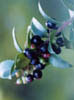
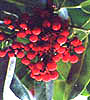
| Evergreen Huckleberry |
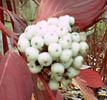
Red Osier Dogwood |
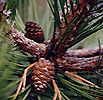
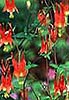
Shore Pine | Western Columbine |
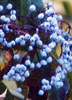
Madrone | Blue Elderberry |
 |
 |
 |
 |
 |
 |
BIRD FAVORITES AT BOSKY DELL
| Food Sources · Birdswholovethem (s=seeds, n=nectar, f=fruit, i=insects, fl=flowers) |
Nesting/Shelter |
TreesConifers
Broadleaf Evergreens
Deciduous
Shrubs&GroundcoversEvergreen
Deciduous
Vines
Grasses and Forbs
|
Treesgolden-crowned sparrow on incense cedar
©Ellen Mast 2003
Shrubs/Groundcovers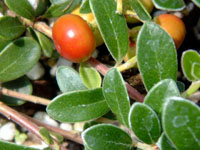 ©Ellen Mast 2003
Vines
Grasses and Forbs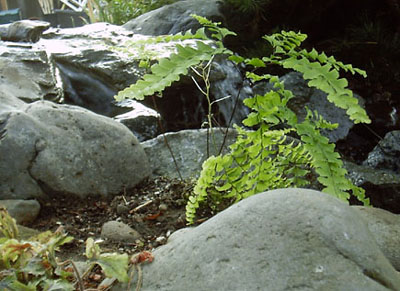 ©Ellen Mast 2003
 |
Plant A Hedgerow*
Hedgerows combine DIFFERENT plants, interwoven in a more natural arrangement than formal hedges, to create the effect of a hedge, provide cover and nesting sites AND food for wildlife, and beauty, all in one marvelous package! Here’s the scoop:
Benefits of hedgerows
- Cover and nesting sites for birds and other wildlife
- Food for (as above): Variety of plants serve wildlife needs throughout the year
- Mosaic of color and texture for your garden
- More natural arrangement requires less intensive management than a formal hedge (and saves you gasoline and loud noise pollution)
Plants for Hedgerows in the Pacific Northwest
Trees
- Abies lasiocarpa, Subalpine Fir
- Acer circinatum, Vine Maple
- Crataegus douglassii, Black Hawthorn
- Malus fusca, Western Crabapple
- Pinus contorta, Shore Pine
- Prunus emarginata, Bitter cherry
- Salix spp., Willow
- Tsuga mertensiana, Mountain Hemlock
- Rhamnus purshiana, Cascar
Shrubs
- Amelanchior alnifolia, Serviceberry
- Arctostaphylos uva-ursi, Kinnikinnik
- Ceanothus spp., Wild Lilac, Buckbrush, Deer Brush
- Cornus stolinifera, Red Osier Dogwood
- Corylus cornuta, Hazel
- Gaultheria shallon, Salal
- Holodiscus discolor, Oceanspray
- Mahonia species, Oregon grape
- Myrica californica, Pacific Wax Myrtle
- Prunus virginiana, Chokecherry
- Ribes sanguineum, Red-flowering Currant
- Rosa spp., Baldhip, Nootka, Clustered and Wood’s Rose
- Sambucus cerulea, S. racemosa, Blue and Red Elderberry
- Sorbus sitchensis, Sitka Mountain-ash
- Symphoricarpos albus, mollis, Common, Creeping Snowberry
- Vaccinium ovatum, parvifolium, Red and Evergreen Huckleberry
- Viburnum trilobum, High Bush Cranberry
Vines
- Lonicera ciliosa, Orange Honeysuckle, Trumpet Vine
- Lonicera hispidula, Chaparral Honeysuckle
Grasses and Forbs
- Aquilegia formosa, Western Columbine
- Asclepias speciosa, Showy Milkweed
- Aster spp., Aster
- Athyrium filix-femina, Lady Fern
- Clarkia spp., Farewell to Spring, Purple Clarkia
- Deschampsia caespitosa, Tufted Hairgrass
- Festuca idahoensis, Idaho Fescue
- Fragaria spp., Coastal, Woods, Wild Strawberry
- Lupinus rivularis, Stream-Bank Lupine
- Polystichum munitum, Sword Fern
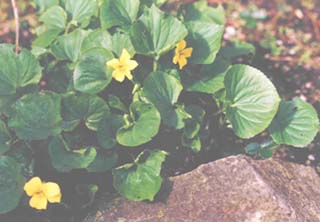
- Viola spp., Evergreen, Streambank, Early Blue Violets
Planting Guidelines
- Choose plants that will thrive in the conditions of soil, moisture, and sun exposure of your site.
- Plant taller evergreen and deciduous trees and shrubs toward the back, if viewed from one side.
- Combine fast and slow growers for immediate effect, food and shelter, and for lasting bounty: Huckleberry grows slowly, Spiraea quickly, and Elderberry will fruit and nectar soon.
- Use a variety of plants to provide food and shelter at all times of year. Combine evergreens and deciduous plants for a more beautiful arrangement, and to provide fruit, seeds, and shelter for wildlife.
- Plant thorny plants and suckering plants – your hedgerow will become dense and provide protection and shelter for wildlife: Black Hawthorn, Rosa species, Oregon grape, Snowberry.
- If you are planting in a small space, limit the number of plants that get large or sucker aggressively, and allow those plants plenty of room.
- Intermix your hedgerow plants so they can “spread their wings”, yet create the sheltering effect of a thicket.
- Create two or three rows of plantings spaced to provide for the needs of each plant and alternating between food sources, shelter, and seasonal interest.
- Butterfly plants should be planted on the south or west side of the hedgerow, where warmth and protection from wind is greatest.
- Remember, diversity is the key to success in attracting wildlife, and there are many ways to create a hedgerow – use your imagination and let nature do the rest!
*Resources used for this section include Landscaping for Wildlife by Russell Link (1999, Washington Dept. of Fish and Wildlife) and (especially for inspiration) Noah’s Garden by Sara Stein (1993, Houghton Mifflin Co., New York)
Bird Websites
Bird Books
- The Backyard Bird Feeder’s Bible. Roth, Sally, Rodale Inc., St. Martin’s Press, 2000
- Landscaping for Wildlife in the Pacific Northwest. Link, Russell, Washington Dept. of Fish and Wildlife, University of Washington Press, 1999
- The Sibley Buide to Birds. Sibley, David, National Audubon Society, Alfted A. Knopf, New York, 2000, (North American bird identification).
- The Sibley Guide to Bird Life and Behavior. Sibley, David, National Audubon Society, Alfred A. Knopf, New York, 2000, (companion to above, with extensive guide to behavior, how birds live and what they do).
- Noah’s Garden. Stein, Sara, Houghton Mifflin Co., New York, 1993.
- The Audubon Society Field Guide to North American Birds, Western Region. Alfred A. Knopf, Inc., New York.
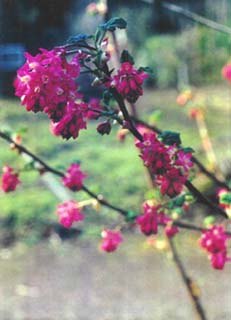
Red Flowering Currant
Ribes sanguineum, or red-flowering currant, provides an excellent example of a shrub every hedgerow should have: The berries, which ripen in the summer, are eaten by robins, towhees, thrushes, waxwings, sparrows, jays and woodpeckers. The striking red pendant flower clusters bloom in early spring, and provide nectar for hummingbirds and butterflies, and the foliage is eaten by some butterfly larvae. The deciduous leaves turn lovely shades of red and orange in the fall. The only time this shrub isn’t doing anything obviously spectacular is in winter, when you can wait in anticipation of its early spring glory!
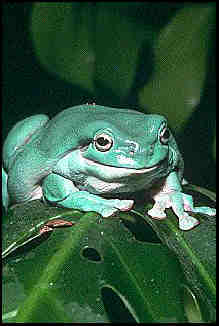
Pacific Treefrog
Hedgerows provide habitat for all sorts of wildlife, including this amphibian (above), who spends part of her time in water, and part on land. The shelter of a generously planted hedgerow is just what this adult treefrog needs during the non-breeding season. It provides protection during dry spells and long daylight hours, and the treefrog can emerge safely at night. Treefrogs lay eggs in aquatic environments like ponds and even small puddles. You may hear their chorusing in early spring, when males call to attract females.